
What are the certificates needed for a water purifier business?

Certificates needed for a water purifier business is one of the first questions every entrepreneur, manufacturer, distributor, or dealer asks before entering India’s rapidly growing water purification industry. Whether you plan to manufacture RO water purifiers, assemble components, distribute branded products, or launch your own water purifier brand, obtaining the correct registrations and certifications is essential for legal compliance and customer trust. Government approvals also help businesses participate in tenders, partner with dealers, and improve their market reputation.
The water purifier industry in India is booming as consumers are becoming cognisant of the contaminants in water and the TDS levels, bacteria, and viruses that are in water. As competition is on the rise and consumers are focusing on certified products as opposed to choosing based on the lowest-priced products, certifications illustrate that a company subscribes to the quality and safety standards. For manufacturers, this most often means that the product is tested and approved before it is allowed to be sold in the market. Dealers and distributors are also confident in the certified brand because it assures the customers and business clients of the certified brand. It will be necessary to have different certifications in line with your business model, such as BIS, GST, trademark, ISO, MSME/Udyam, and Import Export Code (IEC), for certification if you are going to be importing/exporting goods. Some of these certifications will be mandatory, and others will not be mandatory; however, they will be necessary for your business to grow.
Why Certifications Matter for a Water Purifier Business
Regulatory compliance is just the beginning for water purifiers. Certificates build credibility. Customers will not purchase the purifiers if they cannot trust the product to be safe and to produce clean drinking water. Certifications ensure safety and efficacy and reduce the likelihood of product disputes. They also improve after-sales credibility and enhance the likelihood of getting a dealership.
For manufacturers, getting into retail, government, and corporate supply chains is much easier with certification. Banks and other funding sources consider certified businesses to be of a much lower risk. For this reason, you will see many businesses certifying their products and displaying their certification. In a competitive market, certifying businesses will create a better product that sells more than an uncertified business. Customers recognise certification as a guarantee of quality.
Is BIS certification mandatory for the water purifier business?
What is BIS certification?
Starting a water purifier business requires knowledge about a range of regulatory requirements. The Bureau of Indian Standards (BIS) is India’s national standards body. In India, Bureau of Indian Standards (BIS) certification is mandatory for manufacturers of RO-based water purifiers. BIS certification is the most important regulatory approval, as it is evidence of compliance with the Indian quality standards and helps to establish confidence amongst potential consumers. The Indian Standard for RO-based Point-of-Use Water Treatment Systems is IS 16240:2015. BIS certification is mandatory for products covered under the relevant government quality control orders prior to the marketing of the product in India.
For a new entrepreneur, BIS Certification provides a competitive advantage, as it is a legal requirement. The ISI mark is a licence provided by BIS, and products bearing the ISI mark are preferred by retailers, distributors, government departments, hospitals, and educational and corporate institutions, as the product is certified and conforms to Indian standards. Manufacturers are required to submit product samples for testing, and quality control and inspection are the prerequisites prior to the issuance of the licence. Non-compliance may result in the prohibition of the sale of the product in the Indian market. It is an effective and long-term investment to obtain BIS certification early.
GST Registration for Water Purifier Business
For a water purifier business, acquiring GST registration is essential. This registration allows businesses who are involved in manufacturing and selling products to issue invoices and claim input tax credits. Products can legally be sold all over India with the registration. Without the GST registration, there are risks of limitations, especially if your business is trying to work with big retailers, government contracts, and B2B customers, as they would need possible tax documentation.
As the business expands, the compliance with the GST becomes more valuable. There is more ease in compliance and satisfaction with customers and suppliers. Also, there is a need for compliance for businesses that sell products through e-commerce platforms. When a business deals with customers through e-commerce portals, maintaining GST records helps in getting benefits of loans and attracts investors. Professional water purifier companies consider the GST registration the building block for future growth.
ISO Certifications for Water Purifier Companies
ISO 9001 – Quality Management System
Water purifier businesses seeking certifications are likely to come across ISO 9001. This standard aims to maintain a constant quality management system. Although there is no compulsion to be compliant with any ISO-focused procedure, customers, distributors, and institutional buyers perceive it as a managed business, professionally and deliberately. Companies that comply with ISO 9001 define and document their processes and quality control checks, receive and consider feedback from customers, and practise consistent incremental improvement.
Also, several countries’ and big corporations’ procurements prefer suppliers that have ISO-certified quality systems. Water purifier brands need to differentiate their products, and having ISO 9001 certification is a differentiating factor and a good marketing strategy.
ISO 14001 – Environmental Management
ISO 14001 focuses on managing plastic waste, the efficient use of resources, and sustaining the business and environment. Since the manufacturing of water purifiers involves the use of plastic manufacturing components and packaging and filtering systems, the brand certainly helps sustain the environment and the brand.
ISO 45001 – Occupational Health & Safety
ISO 45001 focuses on making work environments safer, satisfying the need to reduce the risks to the safety of employees. Manufacturing becomes more productive and less interrupted due to the positive improvement of safety procedures and the management of risks and the training of employees.
Trademark Registration
One of the essential certificates to obtain for your water purifier business will be ensuring your brand is protected through trademark registration. Trademarking your business will prevent competitors from using your business name, logo, tagline, or any other aspect of your brand that is protected. In any industry, your brand identity is one of your business’s most significant assets.
After trademark registration, the business owner will legally have exclusive rights to the trademark and may prevent others from using their trademark. Trademark registration ensures the mark will not be used by others, assists with the increase and recognition of the mark, and increases the value of the mark if the business uses dealerships or franchising to grow the business. Companies that trademark their business also help customers feel confident in the credibility of the company.
MSME (Udyam) Registration
Water purifier business certificates will also include MSME (Udyam) registration if applicable. Companies with Udyam Registration will have an easier time obtaining business loans and receiving government subsidies. Credit guarantee schemes and support programmes for small and medium enterprises will also be more accessible for Udyam-certified businesses.
Many startups will register as MSMEs to gain funding and easier access to government contracts. While it isn’t compulsory to register with Udyam, the practical benefits of early growth for the business will help.
Import Export Code (IEC) for Water Purifier Business
An Import Export Code (IEC) is required for a water purifier business because you need it when your business is planning to import RO membranes, filters, pumps, UV lamps, SMPS units, etc. from China, Taiwan, South Korea, etc., or when you are planning to export complete water purifiers. The IEC is issued by the Directorate General of Foreign Trade (DGFT) and is essential for important import or export businesses. In the absence of an IEC, usually customs will not clear any commercial import or export.
The import of quality components for many water purifier brands helps in achieving further product development and controlling the cost of manufacture. Similarly, companies which manufacture quality purifiers aim to sell them in neighbouring and, later, international markets. Obtaining an IEC relaxes borders for clearance, payment and other business activities. IEC also strengthens your reputation with your foreign buyers and suppliers. If your business is selling only in India, obtaining an IEC is not necessary. However, many businesses have experienced that obtaining an IEC, at the time of planning to export, is better than the delays and impact of not having an IEC at the time of export.
Electrical Safety and Product Testing
Water purifier business registrations require compliance with electrical safety and product testing. Most modern RO water purifiers have electrical parts, including pumps, power supplies, UV lamps, controllers, and solenoid valves. These parts must function safely under the normal conditions of a household. Product manufacturers should verify that electrical safety, pressure, leakage, and purification tests meet the necessary standards prior to product launch. BIS certification for applicable RO systems involves product performance and electrical safety tests.
Thorough testing is valuable for manufacturers, as it allows them to identify the weaknesses in their product prior to mass production. It also creates less warranty service burden due to less product failure and increases customer trust. Reliable testing includes assessment of water recovery, contaminant reduction, pressure resistance, electrical leakage, product TDS, and overall product durability. Regulators in the industry trust that a well-tested purifier is a reliable purifier, and so will the customers, not only the regulators.
Additional Licences for Dealers and Distributors in Water Purifier Business
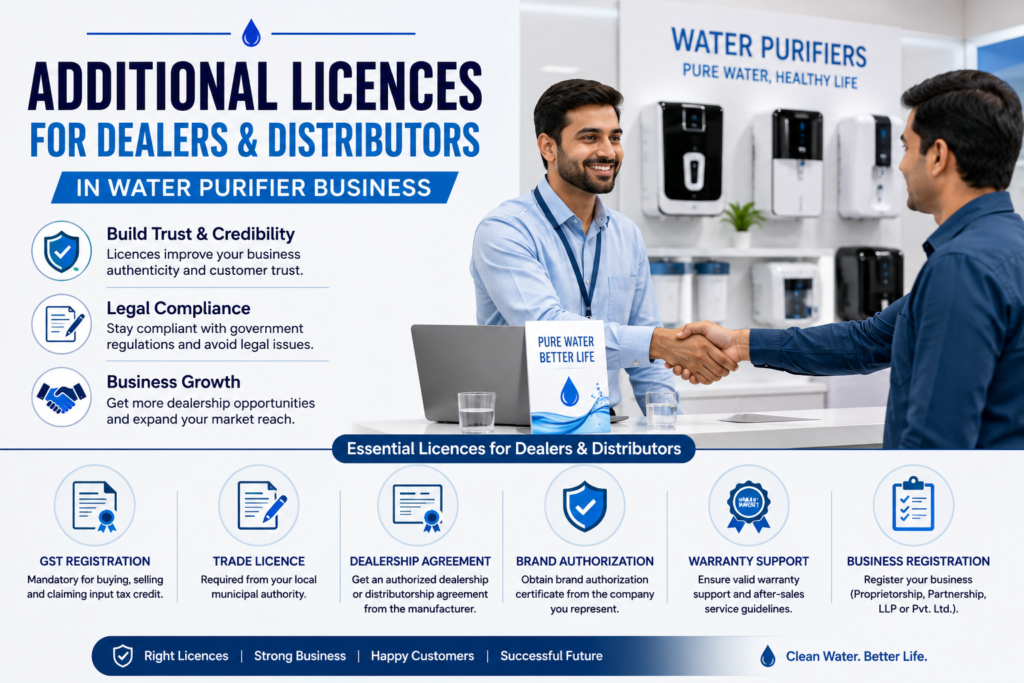
Whether you are a manufacturer, distributor, wholesaler, retailer or service provider, the licensing requirements for a water purifier business differ. Manufacturing licences are generally not required for dealers, but they must be registered for business with a GST registration and keep the invoices of products bought from factory manufacturers. Selling products from manufacturers who are BIS-certified helps dealers avoid issues with business compliance and provides an increase in customer satisfaction and trust.
When going to open a dealership, it helps to get dealership contracts and to develop warranty and service documentation and customer support to help your business. Commercial buyers such as schools, hospitals, hotels, and office businesses and customers prefer a documentation system because it shows long-term business and customer support.
Step-by-Step Process to Obtain Water Purifier Business Certifications
Certificates needed for a water purifier business can seem complicated at first, but following a structured approach makes the process much easier. Rather than applying for every certificate at once, businesses should prioritise mandatory registrations before moving to voluntary certifications that strengthen brand credibility.
| Step | Registration / Certificate | Purpose |
|---|---|---|
| 1 | Company Registration | Establish the legal business entity |
| 2 | PAN & TAN | Tax compliance |
| 3 | GST Registration | Tax invoices and business operations |
| 4 | Trademark Registration | Brand protection |
| 5 | BIS Certification (where applicable) | Product compliance and ISI mark |
| 6 | MSME (Udyam) Registration | Government benefits |
| 7 | ISO 9001 Certification | Quality management |
| 8 | IEC Registration | Import and export activities |
Following this sequence helps avoid unnecessary delays and ensures the business is prepared for expansion. Many companies begin with GST and company registration, then obtain BIS certification before introducing their products to the market. As the business grows, ISO certification, trademark protection, and IEC registration can further strengthen operations and brand value.
Estimated Certification Costs: Water Purifier Business
Certificates needed for a water purifier business involve different costs depending on the size of the business, product range, and certification body. Government fees and professional consultancy charges may vary, so businesses should always verify current pricing with the relevant authorities or accredited service providers.
| Certificate | Approximate Cost (Indicative) |
|---|---|
| Company Registration | ₹5,000 – ₹20,000 |
| GST Registration | Usually free if self-applied |
| Trademark Registration | Government fees plus professional charges |
| MSME (Udyam) | Free |
| IEC Registration | Government fee plus professional charges if applicable |
| ISO 9001 | Varies based on certification body and company size |
| BIS Certification | Depends on product testing, inspections, and licence requirements |
Although certification requires an investment, the long-term benefits often outweigh the initial cost. Certified businesses enjoy better customer trust, easier access to institutional buyers, improved market acceptance, and stronger legal protection.
Common Mistakes to Avoid in Water Purifier Business
Water purifier business certificates shouldn’t be treated as a one-time formality. One of the mistakes that new entrepreneurs make that delays launching products or results in unnecessary complications is assuming that every water purifier requires the same approvals. They actually vary based on the type of product and the model of the business. Entrepreneurs cannot capture the market by using certification logos without authorisation. They also should not sell products that require certifications and approvals that are not in their possession.
Failing to register a trademark is another mistake. A business’s name can be claimed by a competitor if a trademark has not been registered. A business should keep records, renew certifications, and maintain records of quality on a regular basis. Compliance is also achieved when certified laboratories and recognised certification bodies are utilised.
Conclusion
Certificates needed for the water purifier business are critical to establishing a trustworthy business. They are also critical in the water purification industry because they are very competitive. The mandatory requirements that are for specific products and business activities are complemented by registration of GST and company registration and, if required, BIS certification. Certification will improve the efficiency of the business and expansion potential. Examples of these are ISO 9001 certification, trademark registration, MSME (Udyam) registration, and import-export code (IEC).
Today’s customers are no longer swayed by good pricing alone. Customers expect safe, reliable products that have been manufactured to standards and good pricing. Companies that invest in the right certifications gain the trust of the customers, open up business opportunities with dealers and institutional clients, and provide the company with the ability to grow in the correct direction. If a person is planning to start a water purifier company, manufacture ROs, or become a distributor, obtaining the necessary certifications is a good direction to take.
Frequently Asked Questions (FAQs)
- Is BIS certification a must for water purifiers in India?
BIS certification is a must for RO-based Point-of-Use (PoU) water treatment systems. Check the latest standards and notifications for the product.
- Which registration is a must to start a water purifier business?
Legal business registration and GST registration (if applicable) are a must. As for manufacturers, they must obtain product certification (if applicable) prior to the sale of the product.
- Is ISO certification a must?
No. ISO certification is not a must. However, it is recommended since it enhances the credibility of the business, management of the business processes, and customer satisfaction.
- Do water purifier dealers need BIS certification?
Dealers do not obtain BIS certification for the products they do not manufacture. However, they must obtain products from compliant manufacturers and have proper business registrations and documentation.
- Am I allowed to import RO water purifier components without an IEC?
Any commercial import-export activities usually require an Import Export Code (IEC) issued by DGFT.