
Choosing which water purifier is best today feels a bit like standing in front of three doors and guessing which one keeps your family safest. One says RO, another says UV, and the third says UF. All promise pure water. All claim to be the best. But here’s the truth—the best water purifier depends on your water quality.
That’s the biggest mistake most homeowners make. They buy based on brand, price, or advertisements instead of checking their water source. In 2026, the water purifier market in India has crossed nearly ₹3,800 crore, and experts say demand is increasing because more households are dealing with mixed water sources like borewell, tanker, and municipal supply.
If you’ve been asking yourself which water purifier is best, this guide will make it simple. No confusing technical jargon. No sales talk. Just a practical breakdown.
Why Choosing the Right Water Purifier Matters
Water looks clean. That’s the trick.
A glass of water can be crystal clear and still contain invisible enemies—bacteria, viruses, fluoride, arsenic, nitrates, and dissolved salts. Think of it like a beautiful apple that’s rotten inside. Looks can deceive.
In many Indian homes, especially in growing cities, water quality changes often. During summer, tanker water gets mixed with municipal water. In rainy seasons, contamination spikes. In apartments, overhead tanks can collect bacteria if cleaning is delayed.
Drinking unsafe water regularly can cause:
- Stomach infections
- Kidney stones
- Liver issues
- Heavy metal poisoning
- Long-term digestive problems
That’s why buying the wrong purifier isn’t just wasting money—it’s risking health.
And here’s the thing: RO isn’t always necessary. Sometimes UV or UF is enough.
What Is a Water Purifier?
A water purifier is a device designed to remove harmful contaminants from drinking water. But not all purifiers remove the same things.
Imagine three security guards.
- One checks ID cards (UF)
- One kills intruders (UV)
- One removes everything suspicious (RO)
Each has a different job.
That’s why understanding purification technology matters.
Understanding TDS Levels
Before choosing, know your TDS (Total Dissolved Solids).
TDS means dissolved minerals, salts, and metals present in water.
| TDS Level | Water Condition | Recommended Purifier |
|---|---|---|
| 0–200 ppm | Low TDS | UV / UF |
| 200–500 ppm | Moderate TDS | RO + UV |
| 500+ ppm | High TDS | RO |
According to recent purifier industry guides in 2026, TDS remains the most important factor in deciding purification technology.
Think of TDS like sugar in tea. If there’s too much, the taste changes—and so does safety.
What Is an RO Water Purifier?
RO stands for Reverse Osmosis.
This is the heavyweight champion of purification.
It pushes water through a semi-permeable membrane so fine that it blocks dissolved salts, chemicals, and heavy metals.
How RO Technology Works
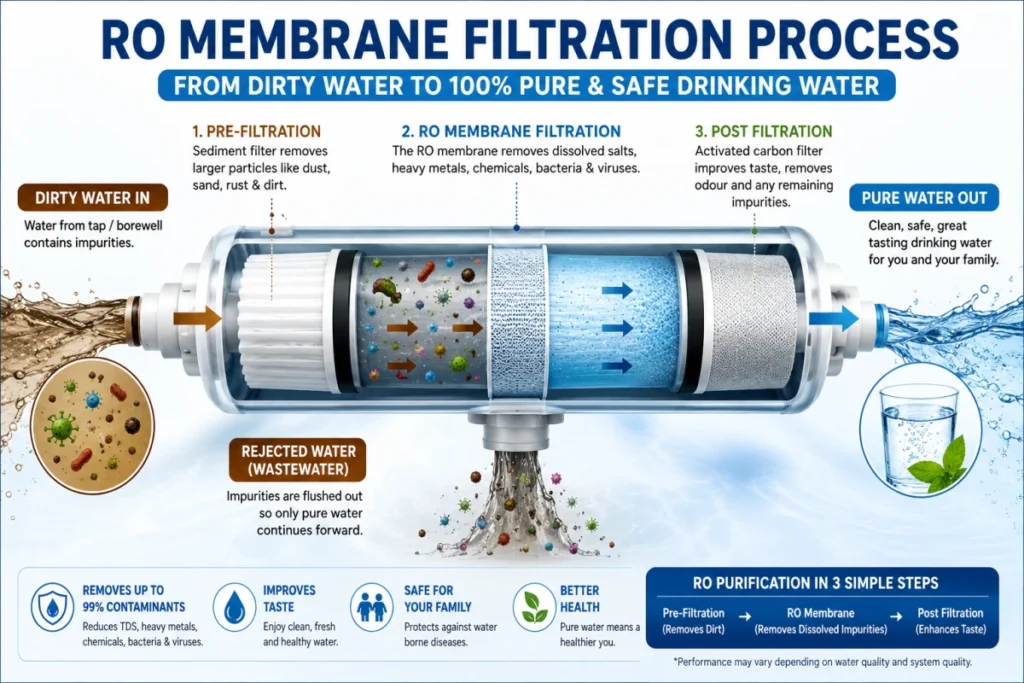
RO removes:
- Lead
- Arsenic
- Fluoride
- Nitrates
- High TDS
- Bacteria
- Viruses
It’s like passing water through a microscopic gate where only clean water can enter.
That’s why RO is considered the best for:
- Borewell water
- Hard water
- High TDS water
- Tanker water
Which Water Purifier Is Best for High TDS Water? Pros of RO Water Purifier
- Removes dissolved impurities
- Improves taste
- Removes heavy metals
- Best for hard water
- Effective against chemical contamination
Cons of RO Water Purifier
- Wastes water
- Requires electricity
- Higher maintenance
- Removes some natural minerals
RO is powerful, but using it on already clean low-TDS water is like using a bulldozer to move a chair. Overkill.
What Is UV Water Purifier?
UV stands for Ultraviolet purification.
Instead of filtering water physically, it uses UV rays to kill microorganisms.
Think of sunlight through a magnifying glass burning germs.
Which Water Purifier Is Best for Municipal Water? What UV Purifier Removes
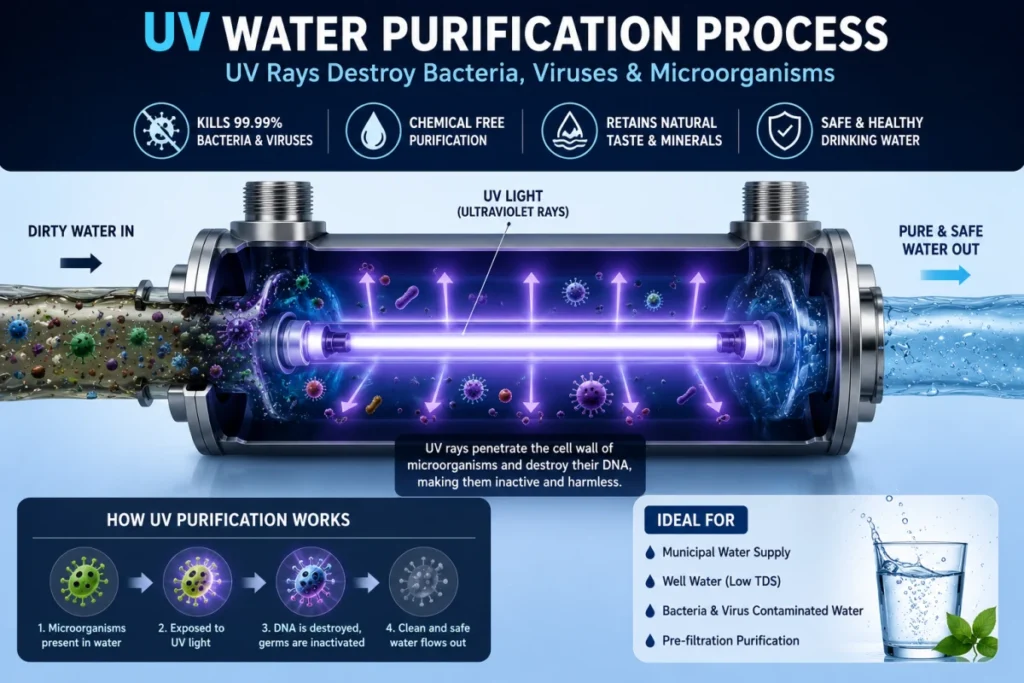
Water passes through a chamber where UV light attacks DNA of bacteria and viruses, making them inactive.
UV removes:
✔ Bacteria
✔ Viruses
✔ Microbes
But UV does not remove the following:
✘ TDS
✘ Heavy metals
✘ Chemicals
✘ Salts
That’s the key difference.
Pros of UV Water Purifier
- Kills germs fast
- No water wastage
- Retains minerals
- Low maintenance
- Faster purification
Cons of UV Water Purifier
- Doesn’t reduce TDS
- Cannot remove chemicals
- Needs electricity
Best for:
- Municipal water
- Already treated water
- Low TDS water
If your city supply is clean but storage tanks worry you, UV is a smart choice.
What Is UF Water Purifier?
UF means Ultrafiltration.
It works through a hollow fiber membrane that removes larger impurities.
Imagine a fishing net catching fish but letting water pass.
That’s UF.
How UF Technology Works
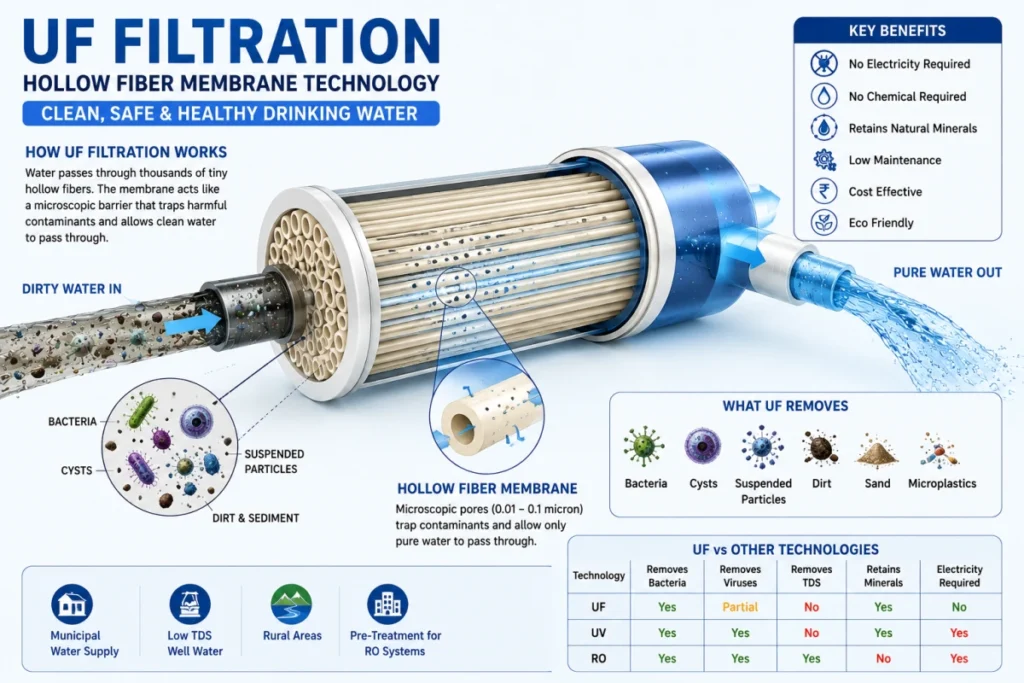
Which Water Purifier Is Best for Basic Filtration? What UF Purifier Removes
✔ Dust
✔ Mud
✔ Bacteria
✔ Suspended particles
It doesn’t remove:
✘ Dissolved salts
✘ Chemicals
✘ Viruses effectively
Pros of UF Water Purifier
- No electricity required
- Low cost
- Easy maintenance
- Keeps minerals intact
Cons of UF Water Purifier
- Limited purification
- Not ideal for highly contaminated water
UF is perfect for:
- Rural homes
- Gravity-based systems
- Low contamination areas
Simple. Cheap. Effective for basic filtration.
Which Water Purifier Is Best? RO vs UV vs UF: Image Comparison Guide
Here’s the easiest way to understand:
| Feature | RO | UV | UF |
|---|---|---|---|
| Removes TDS | Yes | No | No |
| Removes Heavy Metals | Yes | No | No |
| Kills Bacteria | Yes | Yes | Yes |
| Kills Viruses | Yes | Yes | Limited |
| Removes Chemicals | Yes | No | No |
| Electricity Needed | Yes | Yes | No |
| Water Wastage | Yes | No | No |
| Best For | High TDS | Municipal | Basic Filtration |
This table alone answers most people asking which water purifier is best.
Which Water Purifier Is Best Based on Water Source?
This is where the real answer lies.
For Borewell Water
Borewell water often contains:
- High TDS
- Hardness
- Fluoride
- Heavy metals
Best choice?
RO purifier
No debate here.
RO handles dissolved impurities like a specialist surgeon.
For Municipal Water
Municipal water is usually pre-treated.
Main risk:
- Bacteria from old pipelines
- Tank contamination
Best choice?
UV purifier
You keep natural minerals while killing harmful germs.
For Tanker Water
Tanker water is unpredictable.
One day clean. Next day questionable.
Experts increasingly recommend RO + UV hybrid systems for mixed water sources in 2026.
Best choice:
RO + UV
Because uncertainty needs stronger protection.
Hybrid Purifiers (RO + UV + UF): Are They Worth It?
Short answer?
Yes—if your water source changes often.
Think of hybrid purifiers as having three layers of armor.
RO removes dissolved impurities.
UV kills microorganisms.
UF removes physical particles.
Benefits:
- Complete purification
- Better adaptability
- Suitable for Indian urban homes
- Handles changing water quality
The downside?
Higher price.
But if your source is inconsistent, hybrids are often the safest long-term investment.
How to Decide Which Water Purifier Is Best for Your Home
Before buying, do this:
1. Test Water TDS
Use a TDS meter.
It costs less than ₹300.
This one small test can save you ₹10,000+ on unnecessary purification.
2. Identify Water Source
Ask:
Is it borewell?
Municipal?
Tanker?
This changes everything.
Which Water Purifier Is Best? Understanding Water Contamination Types
Low TDS + bacterial risk = UV
High TDS + chemical risk = RO
Physical dirt only = UF
Simple formula.
Expert Advice: What Professionals Recommend
Water treatment experts in 2026 agree on one thing:
“Match technology with contamination, not marketing.”
That’s powerful advice.
Too many brands push RO because it sounds premium.
But premium doesn’t always mean necessary.
A Reddit discussion from Indian buyers this year also showed that many users with low TDS water regretted buying RO because it over-purified water.
That’s like peeling an onion until nothing remains.
Which Water Purifier Is Best for Your Family? Final Buying Decision Guide
Here’s the shortest answer:
- RO is best for high TDS, hard water, and borewell supply
- UV is best for municipal treated water
- UF is best for low contamination and basic filtration
- RO+UV+UF is best for mixed or uncertain water sources
There’s no universal winner.
The real winner is the purifier that matches your water.
That’s the secret.
Conclusion
Choosing between RO, UV, and UF doesn’t have to feel confusing anymore.
The smartest thing you can do before buying is test your water. That single step changes the entire decision. If TDS is high, go with RO. If your water is already treated and mainly needs germ protection, UV is enough. If your water is relatively clean and you want a budget-friendly option, UF works well.
Water is the fuel of your body. You wouldn’t pour dirty fuel into your car, right? So why compromise when it comes to your family’s drinking water?
If you’re still asking which water purifier is best, remember this:
The best purifier is not the most expensive one—it’s the right one.
FAQs
1. Which water purifier is best for home use?
It depends on water quality. RO for high TDS, UV for municipal water, and UF for low contamination water.
2. Is RO better than UV water purifier?
RO is better for removing dissolved salts and heavy metals. UV is better only for killing germs.
3. Can UV purifier remove TDS?
No. UV cannot remove TDS, salts, or chemicals.
4. Which is better RO or UF?
RO is better for chemical and salt removal. UF is better for simple filtration.
5. Is RO + UV + UF worth buying?
Yes, especially if your water source changes frequently or has mixed contamination.