
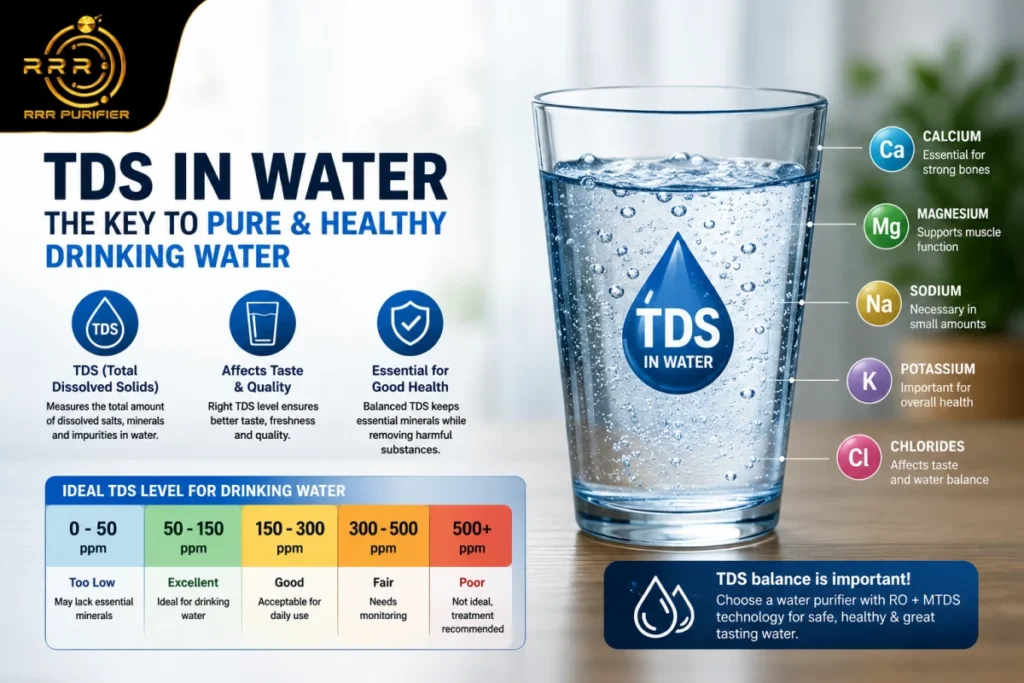
TDS in drinking water is one of the most important requirements for a healthy life. While many people check whether their water looks clean, very few understand the quality of the water they consume every day. One of the most important indicators of water quality is TDS (Total Dissolved Solids).
If you’ve ever wondered what TDS in drinking water is, you’re not alone. TDS is one of the most discussed topics when choosing a water purifier, especially for homes that rely on borewell water or groundwater. Understanding TDS helps you decide whether your water needs purification and which type of purifier is suitable for your home.
Many households across India receive water from different sources, including municipal supply, borewells, wells, and tankers. Each source has a different TDS level, and the quality can vary significantly depending on the region. Areas such as Hyderabad, Chennai, Bengaluru, Coimbatore, and many parts of Telangana, Tamil Nadu, Karnataka, and Andhra Pradesh often experience high-TDS groundwater that requires advanced purification.
In this guide, you’ll learn what is TDS in drinking water, why it matters, the ideal TDS level for drinking water, international and Indian drinking water standards, and how technologies like RO and MTDS help provide safe, great-tasting drinking water.
What is TDS in drinking water?
TDS stands for Total Dissolved Solids, which refers to the total amount of dissolved substances present in water. These substances include minerals, salts, metals, and organic matter that are too small to be seen with the naked eye.
Unlike visible dirt or mud, dissolved solids remain suspended in water and require specialized filtration methods to remove or balance them.
When people ask what TDS in drinking water is, they are essentially asking how much dissolved material is present in their drinking water. TDS is measured in parts per million (ppm) or milligrams pe (mg/L). A higher TDS value means the water contains more dissolved substances, while a lower value indicates fewer dissolved solids.
Not all dissolved solids are harmful. Many minerals such as calcium, magnesium, and potassium are naturally present in water and contribute to its taste and nutritional value. However, excessive levels of salts, heavy metals, fluoride, nitrates, or other contaminants can affect water quality and may require purification.
Understanding what “Er” is contains the following: TDS in drinking water is the first step toward selecting the right water purification system for your home.
Why Does TDS Matter?
Knowing what TDS in drinking water is important because TDS directly affects the quality, taste, and usability of water.
1. Taste of Water
The mineral content of water plays a major role in how it tastes.
- Very low TDS water may taste flat.
- Balanced TDS water tastes fresh and pleasant.
- High TDS water often tastes salty, bitter, or metallic.
This is why many modern water purifiers include MTDS technology to maintain an ideal mineral balance after purification.
2. Water Safety
High TDS does not automatically mean water is unsafe, but it often indicates the presence of excessive dissolved substances. Testing water quality helps identify whether additional purification is required.
3. Household Appliances
Water with high TDS and hardness can lead to scale formation in the following: you
- Electric includes technologies that contain
- Water heaters
- Coffee machines
- Washing machines
- Dishwashers
- Water pipelines
Over time, these deposits reduce efficiency and shorten appliance life.
4. Overall Drinking Experience
Balanced TDS contributes to:
- Better taste
- Improved hydration
- Mineral-rich drinking water
- Consistent water quality
What Makes Up Total Dissolved Solids? searching forwater is,
To understand what TDS is in drinking water, TDS technologies that contain the following help to know what contributes to TDS.
Common dissolved substances include:
Beneficial Minerals
These naturally occurring minerals support water quality and taste.
- Calcium
- Magnesium
- Potassium
- Sodium (within acceptable limits)
Naturally Occurring Salts
As groundwater moves through soil and rocks, it dissolves minerals such as
- Carbonates
- Sulphates
- Bicarbonates
- Chlorides
These minerals increase the TDS level of water.
Trace Elements
Small quantities of trace elements may also be present depending on local geology.
Organic Matter
Decaying vegetation and naturally occurring organic compounds can contribute to dissolved solids.
Unwanted Contaminants
In some regions, groundwater may contain elevated levels of:
- Fluoride
- Nitrates
- Heavy metals
- Industrial pollutants
- Agricultural runoff
This is one reason why high-TDS borewell water often requires advanced purification.
Sources of TDS in Drinking Water
The TDS level of water depends largely on its source.
Borewell Water
Borewell water usually has the highest TDS because it passes through underground rock formations for many years, dissolving minerals and salts.
Typical borewell water may contain the following:
- Calcium
- Magnesium
- Iron
- Fluoride
- Dissolved salts
- Heavy metals (in some locations)
This is why RO-based purification is commonly recommended for borewell water.
Municipal Water
Municipal water generally has lower TDS because it undergoes treatment before distribution. However, the TDS level may still vary depending on the source and local infrastructure.
River and Lake Water
Surface water usually has lower dissolved solids than groundwater but may contain biological contaminants, sediments, and microorganisms requiring different purification methods.
Tanker Water
The quality of tanker water varies widely depending on where it is sourced. Testing the TDS level before use is recommended.
Ideal Levels of TDS in Drinking Water
One of the most common questions after understanding what TDS in drinking water is: What is the ideal TDS level?
The answer depends on maintaining a balance. Drinking water should contain essential minerals while avoiding excessive dissolved solids.
| TDS Level (ppm) | Water Quality | Recommendation |
|---|---|---|
| Below 50 | Very Low | May taste flat and lack essential minerals |
| 50–150 | Excellent | Ideal balance of minerals and taste |
| 150–300 | Good | Suitable for daily drinking |
| 300–500 | Fair | Purification may improve taste |
| Above 500 | High | RO purification is generally recommended |
| Above 1000 | Very High | Not recommended without treatment |
For most Indian households, especially those using borewell water, maintaining purified water within an appropriate TDS range offers a good balance of safety and taste.
WHO & BIS Recommendations for Drinking Water
Many people searching for what TDS in drinking water is also want to know the recommended standards.
World Health Organization (WHO)
The World Health Organization does not specify a strict health-based limit for TDS. However, it notes that water with very high TDS may become less palatable because of its salty or bitter taste, while moderate mineral content generally improves acceptability.
Bureau of Indian Standards (BIS)
The BIS IS 10500 standard recommends the following:
- 500 ppm as water is the desirable limit for TDS in drinking water.
- Up to 2,000 ppm may be permissible in situations where no alternative safe water source is available, provided the water is otherwise acceptable.
Although these standards provide guidance, the ideal TDS level also depends on the specific minerals present. Water quality should always be assessed based on both TDS and contaminant testing rather than TDS alone.
Importance of TDS in Drinking Water
Understanding what TDS in drinking water is important because it helps families make informed decisions about water purification.
Monitoring TDS can help you:
- Evaluate the quality of your drinking water.
- Decide whether an RO purifier is necessary.
- Identify changes in your water source.
- Maintain better taste and mineral balance.
- Protect your family from excessive dissolved contaminants.
- Extend the life of household appliances by reducing scale formation.
If your home relies on borewell water, checking the TDS level regularly with a digital TDS meter is one of the simplest ways to monitor water quality. Combined with the right purification technology—such as an RO purifier with MTDS and mineral enhancement—you can enjoy clean, safe, and balanced drinking water every day.
High TDS vs. Low TDS Water: Which is Better?
After understanding what water is, TDS in drinking water wavrecommends the following for mineral content. Er, drinking water, the next important question is whether high TDS or low TDS water is healthier. The answer lies in maintaining the right balance rather than simply aiming for the highest or lowest TDS value.
Low TDS Water
Low TDS water generally contains fewer dissolved minerals. Water with a TDS level below 50 ppm is often produced by advanced RO systems that remove nearly all dissolved solids.
Advantages
- Clean and purified
- Free from most dissolved contaminants
- Suitable when source water has high pollution levels
Limitations
- May taste flat or bland
- Contains very few naturally occurring minerals
- May not provide the pleasant taste many people prefer
This is why many modern RO purifiers include technologies like liter technologies to improve both taste and mineral balance.
High TDS Water
High TDS water contains a greater concentration of dissolved substances. These may include beneficial minerals or unwanted contaminants.
Possible Benefits
If the dissolved solids mainly consist of calcium and magnesium, the water may taste richer and contribute to mineral intake.
Potential Concerns
When TDS becomes excessively high, water may contain the following:
- Excess salts
- Fluoride
- Nitrates
- Heavy metals
- Industrial contaminants
These substances can affect both taste and overall water quality.
High-TDS water often tastessearching fo
- Salty
- Bitter
- Metallic
For this reason, homes using borewell water commonly require RO purification.
Health Impacts of High and Low TDS Water
Many people believe that TDS alone determines whether water is healthy. In reality, the composition of dissolved solids is more important than the TDS number itself.
Health Effects of High TDS Water
High TDS does not automatically make water unsafe, but it may indicate the presence of unwanted dissolved substances.
Potential issues searching include the following:
- Poor taste
- Excessive hardness
- High fluoride levels in some regions
- Elevated sodium content
- Scaling in plumbing and appliances
When high TDS results from harmful contaminants, advanced purification becomes essential.
Health Effects of Extremely Low TDS Water
Water with very low TDS is generally purified but may lack naturally occurring minerals such as calcium and magnesium.
While drinking low-TDS water is not necessarily harmful for healthy individuals with a balanced diet, many people prefer mineral-balanced water because it offers:
- Better taste
- Improved mouthfeel
- A more natural drinking experience
Modern water purifiers solve this issue by restoring essential minerals and TDS after RO purification.
TDS and RO Purification
If yosearching forsearching foru are searching forineralg what TDS in drinking water is, you are likely also considering purchasing a water purifier.
Why RO is Recommended
Reverse Osmosis (RO) technology is one of the most effective methods for reducing excessive TDS in drinking water.
An RO membrane removes:
- Dissolved salts
- Heavy metals
- Fluoride
- Arsenic
- Nitrates
- Harmful chemicals
- Excess minerals
This makes RO ideal for homes using borewell water with high TDS.
Does RO Remove Good Minerals?
Yes.
Traditional RO systems remove both harmful impurities and naturally occurring minerals.
Although this improves water safety, it may also affect taste.
This is why many premium water purifiers now include the following: Include the following:
- MTDS Technology
- Mineral Cartridge
- Alkaline Filter
These technologies help restore the taste and maintain balanced mineral content.
Why MTDS Technology is Important
Manual TDS (MTDS) technology allows users to adjust the purified water according to the quality of the incoming water.
Instead of producing extremely low-TDS water, MTDS helps maintain a balanced mineral profile.
Benefits include:
- Better taste
- Balanced drinking water
- Improved hydration
- Natural mineral content
- Consistent water quality
For households using borewell water, RO combined with MTDS offers an excellent balance between purification and taste.
Common Myths About TDS
There are many misconceptions surrounding what TDS in drinking water is. Let’s clear up some of the most common myths.
Myth 1: Higher TDS Means Better Water
Fact: High TDS only indicates that more dissolved substances are present. Those substances may be beneficial minerals—or they may be unwanted salts and contaminants.
Myth 2: Zero TDS Water is the Healthiest
Fact: Extremely low-TDS water is highly purified but may taste flat because most dissolved minerals have been removed. Many people prefer mineral-balanced water for everyday drinking.
Myth 3: TDS Alone Determines Water Quality
Fact: TDS measures the total amount of dissolved solids, not the type of substances present. Water testing should also evaluate contaminants such as bacteria, fluoride, heavy metals, and nitrates.
Myth 4: RO Water Has No Minerals
Fact: Traditional RO removes most dissolved minerals, but modern RO systems with MTDS and mineral cartridges restore essential minerals for improved taste and balance.
Myth 5: Every Home Needs an RO Purifier
Fact: The right purifier depends on your water source and TDS level. Homes using high-TDS borewell water often benefit from RO, while low-TDS municipal water may require different purification technologies.
Why RRR Purifier is Recommended for High-TDS in Drinking Water
If your home relies on borewell water, choosing the right purifier is just as important as understanding TDS.
RRR Purifier is designed specifically for Indian water conditions and delivers advanced multi-stage purification to address common borewell water challenges.
Multi-Stage Purification Process
RRR Purifier combines multiple technologies, including:
- Sediment Filter
- Activated Carbon Filter
- High-Performance RO Membrane
- MTDS Controller
- Mineral Cartridge
- Alkaline Filter
- UV Protection (selected models)
This combination removes harmful contaminants while improving taste and maintaining a balanced mineral profile.
Why Choose RRR Purifier?
RRR Purifier offers several advantages for homes using borewell water.
Key Benefits
- Suitable for high-TDS water
- Removes dissolved salts and impurities
- Reduces fluoride and heavy metals
- Helps reduce water hardness
- Restores essential minerals
- Improves taste naturally
- Energy-efficient operation
- Durable filtration system
- Professional installation support
- Reliable after-sales service
Whether your water source has a TDS of 400 ppm or over 1500 ppm, RRR Purifier provides effective purification for cleaner, healthier drinking water.
Frequently Asked Questions (FAQs)
1. What is TDS in drinking water?
TDS stands for Total Dissolved Solids. It measures the amount of dissolved minerals, salts, and other substances present in water.
2. What is the ideal TDS level for drinking water?
A TDS level between 50 and 150 ppm is generally considered ideal for balancing taste and mineral content, while 150–300 ppm is also suitable for everyday drinking.
3. Is high TDS water harmful?
Not always. High TDS simply indicates more dissolved substances. The health impact depends on what those substances are. Water testing is recommended to identify specific contaminants.
4. Should I use an RO purifier for borewell water?
If your borewell water has a high TDS level or contains excessive dissolved salts, an RO purifier is usually recommended to improve water quality.
5. Does RO remove essential minerals?
Yes. Traditional RO systems remove most dissolved minerals. Modern purifiers with MTDS and mineral cartridges help restore essential minerals while maintaining safe drinking water.
6. How can I check the TDS level of my water?
You can measure TDS using a digital TDS meter. It provides a quick reading in parts per million (ppm), helping you determine whether additional purification is needed.
Conclusion
Understanding what TDS in drinking water is essential for making informed decisions about your family’s drinking water. TDS reflects the concentration of dissolved minerals and salts, but the quality of those dissolved substances matters more than the number alone. While naturally occurring minerals such as calcium and magnesium contribute to taste and nutrition, excessive salts, fluoride, heavy metals, or other contaminants may require treatment.
The ideal solution is not simply choosing high-TDS or low-TDS water—it is choosing balanced, purified water. For households using borewell water or water with elevated TDS, an advanced RO purifier with MTDS and mineral enhancement can provide safe, great-tasting drinking water while maintaining a healthy mineral balance.
By testing your water regularly, understanding your TDS level, and selecting the appropriate purification technology, you can ensure that every glass of water your family drinks is clean, refreshing, and suitable for daily consumption.
Choose RRR Purifier for Safe & Balanced Drinking Water
Looking for a reliable solution for high-TDS borewell water?
RRR Purifier offers advanced RO + MTDS + Mineral + Alkaline purification technology designed for Indian water conditions. Its multi-stage filtration system removes harmful contaminants, reduces excessive dissolved solids, restores essential minerals, and enhances the natural taste of water.
Whether your home uses borewell water, municipal supply, or mixed water sources, RRR Purifier helps you enjoy safe, balanced, and refreshing drinking water every day.
Experience healthier hydration with RRR Purifier—because every family deserves pure water and peace of mind.