
Introduction
RO membrane replacement is one of the most important maintenance tasks for keeping your RO water purifier performing at its best. The RO membrane is the core component responsible for removing dissolved salts, heavy metals, fluoride, bacteria, viruses, pesticides, and many other harmful contaminants from drinking water. As the membrane filters thousands of litres of water over time, it gradually loses efficiency due to scaling, clogging, and continuous exposure to impurities. Replacing it at the right time ensures your family continues to receive safe, clean, and healthy drinking water every day.
Many homeowners only think about servicing their purifier when the water stops flowing or begins to taste unusual. However, by the time these visible signs appear, the membrane may already have been underperforming for several months. A worn membrane can increase TDS levels, reduce water flow, overload the booster pump, and shorten the life of other filters. Understanding how the membrane works and recognising early warning signs can help prevent costly repairs while extending the overall lifespan of your purifier.
This complete guide explains everything you need to know about RO membrane replacement, including how an RO membrane works, why timely replacement matters, and the benefits of proper maintenance. Whether your home uses municipal water or borewell water, following this guide will help you maintain consistent water quality throughout the year.
Table of Contents
- RO Membrane Replacement: Why It Matters
- What Is an RO Membrane?
- How RO Membrane Replacement Protects Your Family
- How an RO Membrane Works
- Benefits of Timely RO Membrane Replacement
- Signs You Need RO Membrane Replacement
- RO Membrane Lifespan
- Factors Affecting Membrane Life
- RO Membrane Replacement Process
- FAQs
RO Membrane Replacement: Why It Matters
RO membrane replacement plays a crucial role in maintaining the performance of every reverse osmosis water purifier. The membrane acts as an advanced filtration barrier that removes microscopic impurities which ordinary filters cannot eliminate. While sediment filters remove visible dirt and carbon filters reduce chlorine and unpleasant odours, the RO membrane performs molecular-level filtration by separating dissolved contaminants from purified water. This makes it the most important component inside the entire purification system.
Every day, the membrane processes hundreds of litres of water containing minerals, dissolved salts, heavy metals, and microscopic impurities. Over time, these contaminants gradually accumulate on the membrane surface, reducing its ability to filter efficiently. As the pores become partially blocked, water production slows, purification efficiency decreases, and the purifier requires more energy to operate. Without timely replacement, water quality continues to decline while other components experience additional wear.
Another reason RO membrane replacement is so important is that water quality changes throughout the year. During the rainy season, higher sediment levels increase the membrane’s workload, while summer often brings higher TDS in borewell water. Regular maintenance ensures the purifier can adapt to these seasonal changes while delivering consistent purification. Homeowners who follow a scheduled maintenance plan usually experience better water quality, lower repair costs, and longer purifier life.
## What Is an RO Membrane?
An RO membrane is a highly engineered semi-permeable membrane used in reverse osmosis water purifiers. It contains microscopic pores that are small enough to allow water molecules to pass while blocking dissolved salts, heavy metals, fluoride, arsenic, nitrates, bacteria, viruses, and many other harmful contaminants. This advanced filtration process produces cleaner and healthier drinking water than conventional filtration methods alone.
Unlike ordinary filters that remove only visible particles, the RO membrane performs the most advanced stage of purification. It significantly reduces TDS while improving water taste and clarity. Because it removes contaminants at the molecular level, the membrane is considered the heart of every RO water purifier.
The membrane works together with sediment filters and activated carbon filters. These pre-filters remove larger particles and chlorine before water reaches the membrane, protecting it from premature damage. Without proper pre-filtration, the membrane would become clogged much more quickly, reducing its lifespan and purification efficiency.
Understanding the importance of the membrane helps homeowners appreciate why RO membrane replacement should never be delayed. A healthy membrane provides consistently safe drinking water while protecting the purifier’s internal components from unnecessary stress.
## How RO Membrane Replacement Protects Your Family
RO membrane replacement directly affects the quality of drinking water consumed by your family. As long as the membrane performs efficiently, it removes a high percentage of dissolved impurities that may otherwise remain in the water supply. These include excessive minerals, fluoride, heavy metals, pesticides, and harmful microorganisms that can affect both taste and long-term water quality.
A worn membrane gradually loses its filtration capability. Although water may continue flowing from the purifier, its ability to reduce dissolved contaminants declines over time. Families often notice only subtle changes at first, such as slightly higher TDS, slower purification, or a change in taste. Replacing the membrane before complete failure ensures these issues do not compromise drinking water quality.
Timely RO Membrane Replacement also protects the entire purification system. A damaged membrane forces the booster pump to work longer, increases energy consumption, and places additional pressure on other filters. Preventive maintenance reduces repair costs while maintaining optimal purifier performance.
For households using borewell water, membrane replacement becomes even more important because groundwater usually contains higher levels of dissolved minerals. Regular servicing ensures the purifier continues delivering safe water despite changing water conditions throughout the year.
How an RO Membrane Works
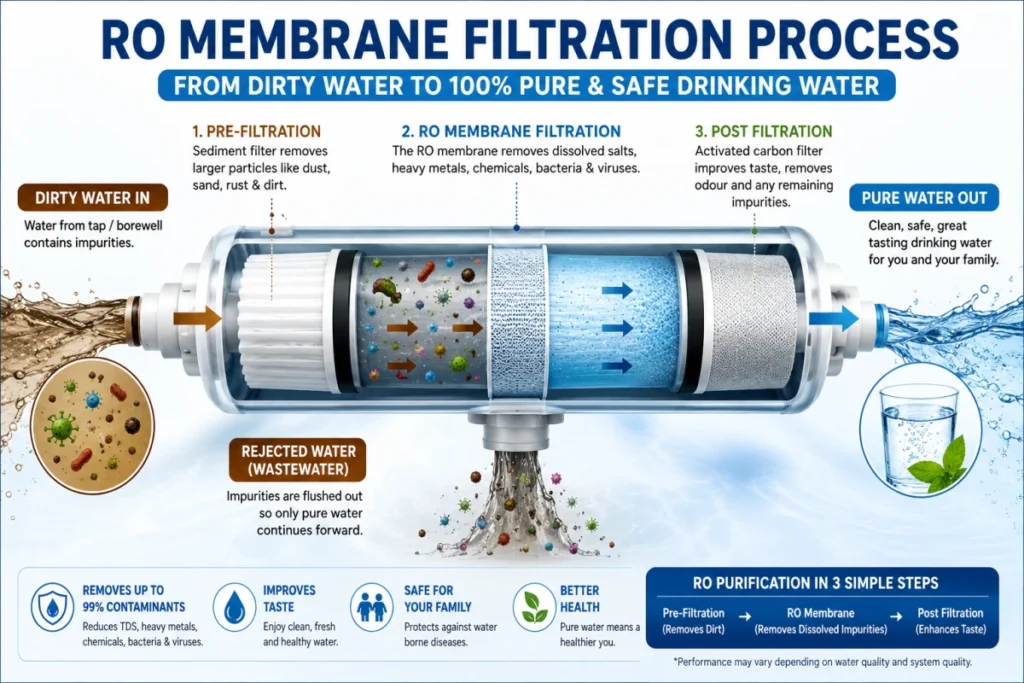
The reverse osmosis process begins with pre-filtration. Incoming water first passes through a sediment filter that removes dust, sand, rust, and suspended particles. Next, an activated carbon filter eliminates chlorine, organic chemicals, and unpleasant odours that could otherwise damage the membrane.
After pre-treatment, water reaches the RO membrane. Under pressure generated by the purifier’s booster pump, water molecules pass through the membrane’s microscopic pores while dissolved salts, heavy metals, fluoride, nitrates, bacteria, viruses, and other contaminants are rejected. The rejected impurities are discharged through the drain line, while purified water continues toward the storage tank.
Because the membrane continuously captures dissolved impurities, gradual scaling and clogging occur over time. The speed of this process depends on water quality, TDS level, daily usage, and maintenance practices. Regular pre-filter replacement significantly extends membrane life by reducing the amount of contamination reaching its surface.
This advanced purification process is why RO membrane replacement remains essential for maintaining consistent drinking water quality and reliable purifier performance.
Benefits of Timely RO Membrane Replacement
Replacing the membrane at the correct time provides several long-term benefits beyond simply maintaining water purity. One of the most noticeable improvements is consistently low TDS, resulting in cleaner, fresher, and better-tasting drinking water. A healthy membrane also helps maintain steady water flow, allowing the storage tank to fill more quickly.
Timely RO membrane replacement reduces strain on the purifier’s booster pump and internal valves. Since water passes more easily through a clean membrane, the purifier operates more efficiently while consuming less electricity. This improved efficiency extends the lifespan of other components and reduces overall maintenance costs.
Another advantage is improved reliability. A properly functioning membrane minimises unexpected breakdowns and provides consistent purification throughout changing seasons. Families can enjoy confidence knowing their purifier continues removing harmful contaminants effectively.
Routine membrane replacement also supports the performance of mineral balancing systems such as MTDS technology. Maintaining optimal purification ensures better water taste while preserving the overall health of the purification system.
Signs You Need RO Membrane Replacement
Although an RO membrane does not suddenly stop working, several warning signs indicate that replacement may soon be necessary.
Common symptoms include:
- Increasing TDS in purified water
- Slow water purification
- Reduced storage tank filling speed
- Salty or unusual water taste
- Frequent purifier servicing
- Reduced water pressure
- Higher electricity consumption
- Technician recommendation after inspection
Ignoring these signs may reduce water quality while increasing repair costs over time.
RO Membrane Lifespan
RO membrane replacement depends on several factors, including incoming water quality, total dissolved solids (TDS), daily water consumption, and regular maintenance. Under normal household conditions, an RO membrane typically lasts 1 to 3 years. However, homes using borewell water with high TDS or hard water may require replacement sooner because the membrane continuously filters a larger amount of dissolved minerals and contaminants. The lifespan should always be determined by purifier performance rather than time alone.
Many homeowners believe that replacing the membrane every year is necessary regardless of water quality. In reality, a properly maintained membrane in a low-TDS municipal water supply may continue performing efficiently beyond two years. On the other hand, a purifier operating in areas with hard borewell water may require membrane replacement within twelve to eighteen months. Regular TDS testing and professional servicing provide a much more accurate indication of membrane health than relying solely on the calendar.
Proper maintenance significantly extends membrane life. Replacing sediment and carbon filters on schedule prevents dirt, rust, chlorine, and organic contaminants from reaching the membrane. Annual servicing also allows technicians to inspect pressure, water flow, and purification efficiency before small issues become major problems. A well-maintained membrane continues producing high-quality drinking water while protecting other purifier components from unnecessary wear.
Factors Affecting RO Membrane Life
Several environmental and operational factors determine how long an RO membrane performs efficiently. Understanding these factors helps homeowners maximise membrane lifespan while reducing long-term maintenance costs.
High TDS Water
Water containing high levels of dissolved salts places additional stress on the RO membrane. Homes using borewell water often experience higher TDS than those supplied by municipal water. As more dissolved minerals pass through the membrane each day, scaling gradually develops, reducing filtration efficiency. Regular maintenance becomes even more important in high-TDS areas because the membrane processes a heavier contaminant load.
Hard Water
Hard water contains elevated concentrations of calcium and magnesium that can form mineral deposits on the membrane surface. These deposits gradually block microscopic pores, reducing water flow and purification efficiency. Using appropriate pre-filtration and replacing filters on schedule helps minimise scaling and extend membrane life.
Sediment Filter Condition
The sediment filter serves as the membrane’s first line of protection by removing sand, rust, dust, and suspended particles before water reaches the RO stage. A clogged or overdue sediment filter allows abrasive particles to reach the membrane, accelerating wear and reducing purification performance. Timely sediment filter replacement significantly increases membrane lifespan.
Activated Carbon Filter Performance
Activated carbon filters remove chlorine and organic chemicals that may damage membrane material. Once the carbon filter becomes exhausted, chlorine reaches the membrane directly, shortening its operational life. Replacing carbon filters every six to twelve months protects the membrane while maintaining better water taste.
Daily Water Usage
Large families naturally consume more purified water each day. Increased water production means the membrane processes greater quantities of contaminants, which may shorten its lifespan compared with smaller households. Choosing the appropriate purifier capacity helps balance workload and improve long-term performance.
Regular Maintenance
Scheduled servicing is one of the most effective ways to maximise membrane life. Professional technicians inspect pressure, sanitise the purifier, measure TDS, and verify that every filtration stage operates correctly. Preventive maintenance reduces the risk of unexpected membrane failure while maintaining consistent drinking water quality.
How Often Should You Replace an RO Membrane?
RO membrane replacement should always be based on water quality, purifier performance, and professional inspection rather than following a fixed replacement schedule. Although many residential membranes last between one and three years, actual replacement intervals vary depending on operating conditions.
Homes receiving treated municipal water generally experience lower TDS and fewer dissolved impurities. Under these conditions, membranes often last longer because they filter fewer contaminants each day. Conversely, households using borewell water frequently require earlier replacement because the membrane continuously removes higher levels of dissolved salts, hardness, and minerals.
Regular monitoring provides the most reliable replacement schedule. A sudden increase in purified water TDS, slower tank filling, reduced water pressure, or noticeable taste changes may indicate that the membrane is approaching the end of its service life. Professional servicing confirms whether replacement is necessary or whether routine filter maintenance will restore performance.
Instead of replacing the membrane prematurely, homeowners should rely on water quality testing and technician recommendations. This approach ensures maximum membrane life while maintaining safe drinking water.
Step-by-Step RO Membrane Replacement Process
Although membrane replacement should ideally be performed by a trained technician, understanding the process helps homeowners appreciate the importance of proper installation and sanitation.
Step 1 – Switch Off the Purifier
Turn off the electrical power and close the incoming water supply before beginning maintenance. This ensures safe handling and prevents accidental water leakage during replacement.
Step 2 – Empty the Storage Tank
Drain all purified water from the storage tank. Removing internal pressure allows the membrane housing to be opened safely without damaging fittings.
Step 3 – Remove the Membrane Housing
Carefully disconnect the membrane housing cap using the correct tool. Avoid excessive force that could damage plastic threads or sealing components.
Step 4 – Remove the Old RO Membrane
Pull out the existing membrane carefully while inspecting it for heavy scaling, discolouration, or physical damage. Excessive deposits often indicate delayed maintenance or poor water quality.
Step 5 – Clean the Housing
Before installing the new membrane, thoroughly clean and sanitise the membrane housing. Removing accumulated dirt and biological deposits prevents contamination of the replacement membrane.
Step 6 – Install the New RO Membrane
Insert a genuine RO membrane into the housing according to the manufacturer’s instructions. Ensure the membrane seats completely and all seals are positioned correctly to prevent bypass leakage.
Step 7 – Reassemble the Purifier
Reconnect the membrane housing securely and restore the water supply. Inspect all pipe connections carefully for leakage before switching on the purifier.
Step 8 – Flush the New Membrane
Flush the purifier according to the recommended procedure before using the water for drinking. This removes protective preservatives from the new membrane and prepares it for normal operation.
Step 9 – Verify Purifier Performance
Measure purified water TDS, check water flow, inspect for leaks, and ensure the storage tank fills normally. These final checks confirm successful membrane replacement.
Comparison: Healthy RO Membrane vs Worn-Out RO Membrane
| Feature | Healthy RO Membrane | Worn-Out RO Membrane |
|---|---|---|
| TDS Reduction | Excellent | Poor |
| Water Taste | Fresh and clean | Salty or metallic |
| Water Flow | Fast and consistent | Slow purification |
| Storage Tank Filling | Normal | Delayed |
| Heavy Metal Removal | Highly effective | Reduced efficiency |
| Filter Performance | Balanced | Additional strain on filters |
| Pump Load | Normal | Higher workload |
| Maintenance Cost | Lower | Higher due to repairs |
| Water Safety | Consistently safe | Purification quality declines |
Expert Maintenance Tips
Proper maintenance is the easiest way to maximise membrane lifespan and maintain excellent drinking water quality.
- Replace the sediment filter every 6 months.
- Replace the activated carbon filter every 6–12 months.
- Schedule annual professional servicing.
- Monitor purified water using a TDS meter.
- Use only genuine RO membranes and replacement filters.
- Flush the purifier after long periods of non-use.
- Inspect the purifier immediately if water flow or taste changes.
- Protect the purifier from extremely muddy water during the rainy season.
- Follow the manufacturer’s maintenance schedule.
These simple practices help extend membrane life while keeping the entire purification system operating efficiently.
Common RO Membrane Replacement Mistakes
RO membrane replacement is a critical part of maintaining an RO water purifier, yet many homeowners unknowingly make mistakes that reduce purification efficiency and shorten the life of the new membrane. Installing a new membrane alone is not enough. The entire purification system—including pre-filters, pressure, water quality, and sanitisation—must work together to deliver safe drinking water. Ignoring these factors can lead to poor water taste, increased TDS, higher maintenance costs, and unnecessary repairs.
One of the biggest mistakes is delaying membrane replacement even after clear warning signs appear. Many people continue using an exhausted membrane because water is still flowing from the purifier. Unfortunately, an old membrane may allow dissolved impurities, heavy metals, and excess minerals to pass into the purified water without obvious changes in appearance. Another common mistake is purchasing low-quality duplicate membranes instead of genuine replacement parts. Inferior membranes often provide poor filtration performance and may fail much sooner than original products.
Replacing only the membrane while leaving clogged sediment and carbon filters unchanged is another serious error. These pre-filters protect the membrane by removing dirt, rust, and chlorine before water reaches the RO stage. When they are overdue for replacement, the new membrane is immediately exposed to harmful contaminants, reducing its lifespan significantly. Regular servicing ensures that every filter is inspected and replaced according to the manufacturer’s recommendations.
Using Duplicate RO Membranes
Many inexpensive replacement membranes available online or in local markets appear similar to genuine products, but their performance can vary greatly. Duplicate membranes often use lower-quality materials and may not provide the same level of TDS reduction or contaminant removal. They may also wear out much faster, resulting in additional replacement costs.
Using genuine membranes designed specifically for your purifier ensures better compatibility, longer service life, and consistent drinking water quality. Genuine spare parts also help maintain the manufacturer’s recommended purification standards.
Ignoring Sediment and Carbon Filters
Sediment filters and activated carbon filters are designed to protect the RO membrane. When these filters become clogged or exhausted, they allow dirt, rust, chlorine, and organic contaminants to reach the membrane directly.
Replacing the membrane without changing worn pre-filters reduces the effectiveness of the new membrane and increases maintenance expenses. Always inspect the complete filtration system during servicing.
Skipping Professional Servicing
Although some homeowners attempt membrane replacement themselves, professional servicing offers several advantages. Trained technicians inspect pressure, sanitise the purifier, flush the membrane correctly, measure TDS, and verify that every filtration stage operates efficiently.
Professional maintenance reduces the risk of installation errors while extending purifier life.
How to Extend RO Membrane Life
A quality RO membrane represents an important investment, and with proper care, it can continue delivering excellent purification for several years. The lifespan of the membrane depends largely on maintenance habits and water quality rather than simply the age of the purifier.
Replacing sediment and activated carbon filters on schedule remains the most effective method for extending membrane life. These filters remove particles and chlorine before water reaches the membrane, preventing premature clogging and chemical damage. Homes using borewell water with high TDS benefit particularly from timely filter replacement because the membrane processes larger quantities of dissolved minerals every day.
Annual servicing also contributes significantly to membrane longevity. During service visits, technicians inspect booster pump pressure, clean the storage tank, measure TDS, sanitise internal components, and evaluate overall purifier performance. Identifying small issues early prevents expensive membrane damage later.
Using a TDS meter periodically helps monitor purification efficiency. A gradual increase in purified water TDS may indicate declining membrane performance before noticeable taste changes occur. Monitoring water quality allows homeowners to schedule maintenance proactively instead of waiting for complete membrane failure.
Finally, always use genuine replacement filters and membranes. Original spare parts are engineered to work together with the purifier, providing better reliability, improved purification efficiency, and longer operating life.
Why Choose Genuine RRR Purifier RO Membranes?
RO membrane replacement becomes much more effective when genuine replacement components are used. RRR Purifier membranes are designed specifically for Indian water conditions, including high-TDS borewell water, municipal water, and mixed water supplies commonly found across many regions. Every genuine membrane undergoes quality testing to ensure dependable purification performance and long-term durability.
The RRR Purifier combines advanced RO, UV, UF, MTDS, mineral, and alkaline purification technologies with premium membrane filtration. Genuine membranes work together with high-quality sediment and carbon filters to remove dissolved salts, fluoride, heavy metals, pesticides, bacteria, viruses, and other harmful contaminants while delivering refreshing drinking water.
Professional RRR Purifier service technicians also perform complete system inspections during every maintenance visit. They evaluate incoming water quality, check purifier pressure, inspect filter condition, sanitise the storage tank, measure TDS, and verify membrane performance. This comprehensive maintenance approach extends membrane life while helping homeowners avoid unexpected repairs.
Choosing genuine RRR Purifier replacement parts ensures consistent water quality, reliable performance, lower maintenance costs, and greater peace of mind for your family.
Conclusion
RO membrane replacement is essential for maintaining the safety, quality, and taste of your drinking water. Since the RO membrane performs the most advanced stage of purification, its condition directly influences TDS reduction, contaminant removal, water flow, and overall purifier efficiency. Ignoring membrane maintenance can gradually reduce purification performance while increasing operating costs and placing additional stress on other purifier components.
Replacing the membrane at the right time, along with regular sediment and carbon filter replacement, annual servicing, and routine water quality monitoring, helps maximise purifier performance for many years. Preventive maintenance is always more economical than waiting for major repairs, and it ensures your family continues receiving safe, healthy drinking water throughout every season.
Whether your home uses municipal water or high-TDS borewell water, following this RO membrane replacement guide will help you maintain consistent purification, improve purifier reliability, and extend the lifespan of your entire RO system.
Frequently Asked Questions
1. How often should RO membrane replacement be done?
Most RO membranes last 1–3 years, depending on incoming water quality, TDS level, water usage, and maintenance schedule.
2. How can I tell if I need RO membrane replacement?
Common signs include higher TDS, slow water flow, unusual taste, increased purifier running time, and recommendations from a service technician.
3. Can I replace the RO membrane myself?
Although it is technically possible, professional installation is recommended to ensure correct fitting, flushing, sanitisation, and performance testing.
4. Does RO membrane replacement reduce TDS?
Yes. A healthy membrane effectively removes dissolved salts and helps maintain low TDS levels according to your purifier’s design and incoming water quality.
5. Why should I choose genuine RRR Purifier RO membranes?
Genuine RRR Purifier membranes provide reliable purification, better compatibility, longer service life, and consistent performance under Indian water conditions.
Keep Your RO Purifier Performing Like New with RRR Purifier
Don’t wait until your purifier stops delivering clean water. If you notice rising TDS levels, slower water flow, unusual taste, or it’s been more than a year since your last service, it’s time for a professional inspection.
Book your RRR Purifier service today for genuine RO membrane replacement, expert maintenance, complete purifier sanitisation, and advanced multi-stage water purification. With RRR Purifier, you can enjoy clean, healthy, and great-tasting drinking water every day while extending the life of your RO system.