
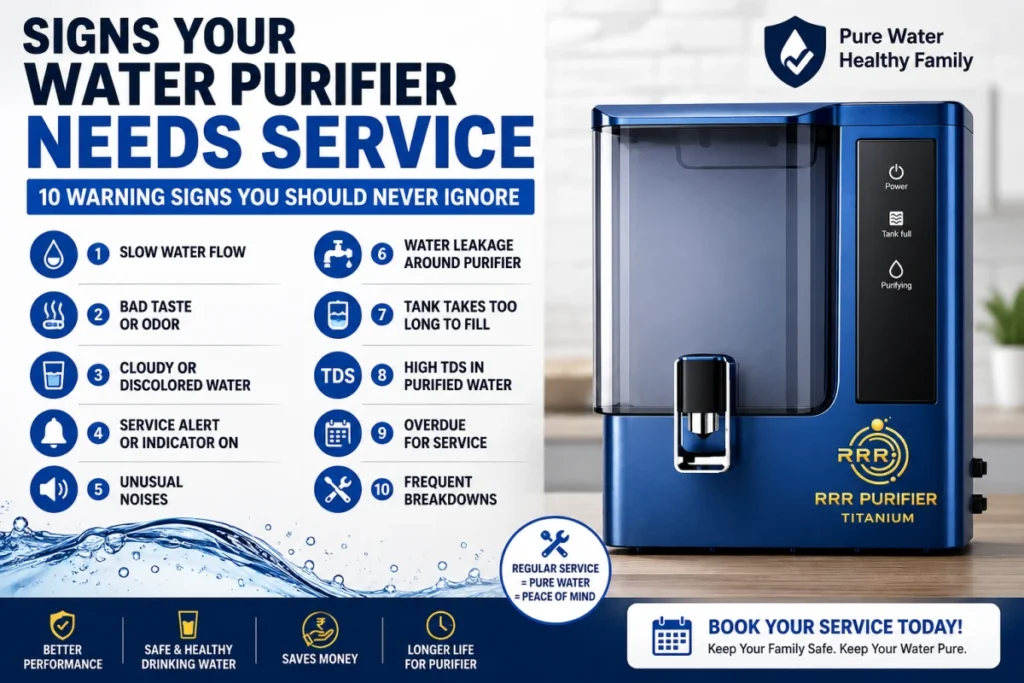
Signs Your Water Purifier Needs Service are often easy to overlook because most water purifiers continue to dispense water even when their filters or internal components are no longer performing efficiently. Over time, sediment filters become clogged, activated carbon filters lose their effectiveness, and RO membranes gradually wear out, reducing the purifier’s ability to deliver safe and great-tasting drinking water. Ignoring these warning signs can lead to poor water quality, higher repair costs, increased water wastage, and a shorter lifespan for your purifier. In this guide, you’ll discover the 10 most common signs your water purifier needs service, understand why timely maintenance matters, and learn when to replace filters to keep your family’s drinking water clean, healthy, and safe every day.
Why Regular Water Purifier Servicing Matters
A water purifier works quietly every day, removing impurities that are invisible to the naked eye. Because it continues to dispense water, many homeowners assume it is functioning perfectly. In reality, the filters, RO membrane, carbon cartridges, and other internal components gradually become clogged with sediment, dissolved salts, chlorine, organic matter, and other contaminants. When these components reach the end of their service life, the purifier may continue to run while delivering water that no longer meets its intended purification performance.
Manufacturers and water treatment experts consistently recommend replacing filters according to the maintenance schedule rather than waiting for the purifier to fail. The U.S. Environmental Protection Agency (EPA) notes that signs such as reduced water production, lower pressure, unusual taste or odour, and overdue filter replacement indicate that maintenance is needed. Depending on water quality and usage, pre-filters are often replaced about every six months, while RO membranes commonly last between one and five years.
Regular servicing also protects the purifier itself. A clogged sediment filter forces the system to work harder, increasing stress on pumps and reducing the lifespan of the RO membrane. Delaying maintenance can lead to higher repair costs, lower purification efficiency, and unnecessary water wastage. Instead of treating servicing as an expense, think of it as preventive care—just as you service a vehicle to keep it reliable, routine maintenance helps your water purifier continue delivering safe, clean drinking water for years.
How an RO Water Purifier Changes Over Time
An RO purifier is made up of several filtration stages, each with a specific purpose. The sediment filter captures sand, dirt, and rust. The activated carbon filter removes chlorine and unpleasant odours. The RO membrane reduces dissolved salts and many contaminants. Depending on the model, additional filters such as mineral cartridges, UV lamps, or post-carbon filters improve taste and final water quality.
Over time, every filter becomes less effective. Sediment cartridges fill with particles, carbon media lose their adsorption capacity, and membranes accumulate dissolved minerals on their surface. This gradual wear is why most purifier issues appear slowly rather than suddenly. You might notice that the storage tank takes longer to fill, the water flow is weaker, or the taste is slightly different before a major problem develops.
Modern purifiers often include electronic service reminders or filter-life indicators to help users identify when maintenance is due. These alerts are designed to prevent reduced purification performance rather than respond to complete failure. Ignoring them may allow clogged filters to affect both water quality and the overall health of the purification system.
Sign #1 – Water Flow Has Become Slow :Water Purifier Needs Service
One of the earliest and most noticeable signs your water purifier needs service is a significant reduction in water flow. If your purifier previously filled a glass in a few seconds but now produces only a slow stream, the filters may be approaching the end of their useful life. Sediment filters frequently become blocked by dirt, rust, and suspended particles, restricting the amount of water that can pass through the system.
Reduced flow is not just an inconvenience. It often indicates that internal components are working under greater pressure than intended. A clogged pre-filter can reduce water reaching the RO membrane, making the purifier less efficient and increasing wear on the pump. As the blockage becomes more severe, the storage tank may take much longer to refill, especially in households with high daily water consumption. Service technicians commonly identify clogged filters as one of the most frequent causes of slow output.
If you notice this symptom, avoid waiting until the purifier stops producing water altogether. Replacing the affected filter at the right time is usually simpler and less expensive than repairing damage caused by prolonged operation with blocked components.
Sign #2 – Water Tastes or Smells Different : Water Purifier Needs Service
Purified water should taste fresh and clean. If the water suddenly develops a chlorine taste, metallic flavour, unpleasant odour, or stale smell, your purifier is sending an important warning. Activated carbon filters gradually lose their ability to absorb chlorine, volatile organic compounds, and odour-causing substances. Once saturated, these contaminants begin passing through the system again.
Taste changes may also indicate declining RO membrane performance or bacterial growth within neglected filters. Because taste and odour changes are easy to detect during daily use, they often become one of the first warning signs homeowners notice. Even if the water still appears clear, a noticeable difference in flavour should not be ignored. Industry maintenance guidance consistently identifies changes in taste and smell as common indicators that filters require replacement or servicing.
When this happens, inspect the purifier’s maintenance history. If it has been many months since the last service, schedule a professional inspection and replace worn filtration components according to the manufacturer’s recommendations.
Sign #3 – Purified Water Looks Cloudy : Water Purifier Needs Service
Clean drinking water should be clear. If you notice cloudiness, floating particles, unusual discolouration, or sediment in purified water, your purifier requires immediate attention. Cloudy water can result from exhausted filters, damaged cartridges, improper installation after previous servicing, or contamination entering the storage tank.
Although temporary tiny air bubbles may disappear after standing for a few minutes, persistent cloudiness should never be dismissed. It can indicate that contaminants are bypassing filtration stages or that the purifier is no longer performing as intended. Continuing to use the purifier without inspection may reduce confidence in the quality of your drinking water and could shorten the life of other filtration components.
Because visual changes are easy to observe, make it a habit to inspect a glass of purified water periodically. A quick visual check often helps identify maintenance needs before they develop into more serious problems.
Sign #4 – The Service Indicator or Filter Alert Has Turned On : Water Purifier Needs Service
Many modern water purifiers include built-in electronic indicators that monitor filter life or operating hours. When the service light changes colour, begins flashing, or the purifier displays a replacement notification, it is time to arrange maintenance. These systems are designed to remind users before filter performance drops significantly.
User manuals for many RO purifiers explain that filter-life indicators change colour or flash when only a small percentage of filter life remains, providing sufficient time to schedule replacement. Ignoring these alerts can reduce purification performance and increase stress on the remaining components.
Instead of resetting the warning without replacing the filter, follow the recommended maintenance schedule. This simple action helps maintain water quality and protects the long-term performance of the purifier.
Sign #5 – Your Water Purifier Makes Unusual Noises: Water Purifier Needs Service
A healthy RO purifier generally operates with a consistent and familiar sound. If you begin hearing loud vibrations, continuous buzzing, clicking, excessive pump noise, or unusual running sounds, the purifier may require servicing. Air trapped in the system, blocked filters, insufficient inlet pressure, or a struggling booster pump can all contribute to abnormal noise.
Another warning sign is when the purifier continues running for an unusually long time without filling the storage tank. This may indicate reduced membrane efficiency, clogged filters, or problems with the automatic shutoff mechanism. The EPA advises that unexpected changes in production rate or pressure should be treated as maintenance indicators rather than ignored.
Unusual sounds are your purifier’s way of asking for attention. Scheduling service early can prevent minor issues from becoming costly repairs and helps ensure that your family continues receiving safe, properly purified drinking water.
Sign #6 – Water Leakage Around the Purifier: Water Purifier Needs Service
Water leakage is one of the clearest signs that your water purifier needs immediate attention. Even a few drops of water around the purifier cabinet, storage tank, or pipe connections should never be ignored. Leaks may occur because of worn-out O-rings, loose tubing, damaged filter housings, cracked storage tanks, or high internal pressure. Over time, these small leaks can become larger, leading to water damage to your kitchen cabinets, walls, or flooring.
Leaks can also affect the purifier’s overall performance. If the system is losing pressure due to a leaking connection, the RO membrane may not receive sufficient pressure to purify water effectively. This can reduce purification efficiency, increase water wastage, and shorten the lifespan of internal components. The EPA recommends addressing maintenance issues promptly because damaged or poorly maintained components can reduce both water quality and system efficiency.
Instead of placing a container under the leak or temporarily tightening the pipe yourself, schedule professional servicing. A qualified technician can inspect the entire purification system, replace damaged seals or fittings, and ensure that the purifier operates safely.
Sign #7 – The Storage Tank Takes Too Long to Fill : Water Purifier Needs Service
Has your purifier started taking much longer to produce drinking water? If filling the storage tank now takes twice as long as before, it usually indicates that one or more filtration components are no longer performing efficiently.
The most common causes include clogged sediment filters, blocked carbon cartridges, a scaling RO membrane, or insufficient inlet water pressure. When filters become saturated with dirt and dissolved minerals, water struggles to pass through them. The purifier still functions, but production slows significantly. You may notice that family members have to wait for the tank to refill before getting another glass of water.
This problem becomes even more noticeable during summer or in larger households where water consumption is higher. Instead of assuming your purifier has become “old”, check when the filters were last replaced. In many cases, replacing the pre-filter or servicing the RO membrane restores normal performance.
If the purifier continues taking an unusually long time even after filter replacement, the booster pump or automatic shutoff valve may require inspection by a service professional.
Sign #8 – High TDS After Purification : Water Purifier Needs Service
Many homeowners now use portable TDS meters to check their purified water. While TDS alone does not determine whether water is safe, a sudden increase in purified water TDS compared to your purifier’s normal output can indicate declining RO membrane performance or incorrect MTDS adjustment.
A damaged or exhausted RO membrane allows more dissolved solids to pass through than intended. Similarly, if the MTDS controller has been incorrectly adjusted after servicing, the purifier may produce water with a higher TDS level than expected. This is why periodic servicing is important—not only to replace filters but also to inspect and calibrate the purification system correctly.
If your incoming water has very high TDS because it comes from a borewell, regular membrane inspection becomes even more important. High mineral content accelerates membrane fouling and reduces purification efficiency over time. According to the EPA, RO membranes generally require replacement every one to five years depending on incoming water quality, maintenance practices, and household usage.
Sign #9 – It Has Been More Than 12 Months Since the Last Service: Water Purifier Needs Service
Even if your purifier appears to be working normally, skipping regular maintenance is not recommended. Filters gradually lose their effectiveness without obvious warning signs. Waiting until the purifier completely stops working usually results in higher repair costs and unnecessary strain on expensive components such as the RO membrane and booster pump.
Routine servicing includes replacing worn filters, sanitising the storage tank, checking water pressure, inspecting valves and tubing, and ensuring that the purifier continues operating efficiently. The EPA also notes that storage tanks should be sanitised periodically to reduce bacterial growth and maintain water quality.
Think of annual servicing as preventive healthcare for your purifier. Regular inspections identify small issues before they become major failures. This not only protects your investment but also ensures that your family continues drinking safe, properly purified water every day.
Sign #10 – Frequent Breakdowns or Repeated Repairs : Water Purifier Needs Service
If your purifier requires repeated repairs within a short period, it is telling you that a more comprehensive inspection is needed. Constant pump failures, recurring leaks, repeated electrical faults, or frequent service visits often indicate that underlying maintenance has been neglected for too long.
Replacing individual parts without addressing clogged filters, membrane scaling, or pressure problems can create a cycle of recurring breakdowns. Instead of spending money on repeated repairs, ask your technician to perform a complete system inspection. A full preventive maintenance service often identifies the root cause and restores long-term reliability.
For older purifiers, professional servicing also helps determine whether replacing certain components is more economical than continuing frequent repairs.
What Happens If You Ignore These Signs?
Ignoring maintenance may seem like a way to save money, but it often leads to much larger expenses later. Dirty filters reduce purification efficiency, clogged membranes decrease water production, and overworked pumps consume more energy while experiencing greater wear.
Neglected purifiers may produce water with reduced taste quality, slower flow, increased water wastage, and inconsistent purification performance. Over time, bacteria can also grow inside storage tanks or old filters if maintenance schedules are ignored. EPA guidance emphasises that proper maintenance is essential because filters and membranes lose effectiveness over time and should be replaced according to the manufacturer’s recommendations.
The safest approach is to schedule servicing as soon as you notice any warning sign instead of waiting for complete system failure.
Recommended Water Purifier Maintenance Schedule
| Component | Recommended Replacement* |
|---|---|
| Sediment Filter | Every 6 months |
| Activated Carbon Filter | Every 6–12 months |
| Post-Carbon Filter | Every 12 months |
| RO Membrane | Every 1–5 years |
| UV Lamp (if applicable) | Around 12 months |
| Storage Tank Sanitization | Once a year |
| Complete Professional Service | Every 12 months |
*Actual replacement intervals depend on incoming water quality, household usage, and the manufacturer’s recommendations.
When Should You Replace RO Filters? : Water Purifier Needs Service
You should replace filters immediately if you notice:
- Reduced water flow
- Unpleasant taste or odor
- Cloudy water
- Service reminder notifications
- Increased purified water TDS
- More than six months since the previous pre-filter replacement
- More than one year without professional maintenance
Following the recommended replacement schedule keeps the purifier efficient and helps extend the life of the RO membrane.Follow the manufacturer’s maintenance schedule along with BIS drinking water standards for better water quality.
Expert Maintenance Tips
Water treatment professionals recommend treating your purifier like any other essential home appliance. A few simple habits can significantly extend its lifespan:
- Replace filters on schedule rather than waiting for failure.
- Sanitise the storage tank during annual servicing.
- Monitor purified water taste and flow regularly.
- Use genuine replacement filters designed for your purifier.
- Arrange professional maintenance once every year.
- If you use borewell water with high TDS, inspect the RO membrane more frequently.
These preventive steps improve purification performance, reduce repair costs, and help ensure consistently safe drinking water.
Conclusion: When Water Purifier Needs Service
Your water purifier protects your family’s health every day, but it also needs regular care to perform at its best. Warning signs such as slow water flow, unusual taste, cloudy water, leaks, frequent noise, delayed tank filling, high TDS readings, or overdue servicing should never be ignored. Addressing these issues early keeps your purifier operating efficiently, extends the life of expensive components, and provides greater confidence in the quality of your drinking water.
Regular maintenance is not simply about replacing filters—it is about ensuring that every stage of the purification process continues working as designed. By following a preventive maintenance schedule and arranging professional servicing when needed, you can enjoy safe, fresh, and reliable drinking water throughout the year.
Frequently Asked Questions
1. How often should I service my RO water purifier?
Most households should schedule a professional service at least once every 12 months, although homes with high-TDS or borewell water may require more frequent maintenance.
2. Can I continue using my purifier if the service light is on?
It is best to arrange service as soon as possible. The reminder indicates that filters or other components may have reached their recommended service interval.
3. How long does an RO membrane usually last?
An RO membrane typically lasts between 1 and 5 years, depending on water quality, usage, and maintenance.
4. Does slow water flow always mean the filters need replacement?
Not always. Slow flow can also result from low inlet pressure, a faulty pump, or plumbing issues, but clogged filters are among the most common causes.
5. Why should I choose RRR Purifier services?
RRR Purifier technicians inspect the complete system, replace genuine filters when required, check purification performance, and help keep your purifier operating efficiently for safe daily drinking water.